Sunday, 17 September 2023

My Heroes – Viorel Ilisoi


If you have had enough of those ‘amazing’ and ‘must (do/ read/ etc.)’ things, then you’re just like me, searching for that human spark, sensibility and goodwill, and thus this book is exactly what you need.

Viorel Ilisoi artfully writes about his heroes. There is care and consideration in his words that seem to blossom from the story and carve the margins. For it seems to me that the stories he tells were already alive before he started telling them and they just needed attire made from Ilisoi’s words to gain a shape we could easily recognize.

I was deeply touched and gladden by his stories. There is such beauty in this rarely seen human kindness!


...

The serious, severe, impenetrable professor suddenly becomes quiet, like a broken clock, and his eyes, like a piece of living glass steamed by the whiteness of old age, start to moisten. He keeps quiet for a long time, yet all his thoughts can be heard.

...

Saturday, 16 September 2023

How to Become Disciplined


I truly believe that useful habits can be learnt. For example, it is very important to realize the difference between personal time and work time. Actually, this is one of the most important lessons I learned, when it comes to self-discipline, and which unfortunately is not on the important-things-to-learn list.

One doesn’t have to reach burn-out status to start taking the necessary measures. To my mind, a healthy organization is one that regularly performs a due diligence check and makes sure that it has among its staff responsible managers, who are oriented not only towards results but also towards their people and who understand that they must not ruin the emotional stability and personal time of employees.


I know of companies that have dedicated internal teams to tackle ethics and professional complaints received from employees, but I must confess that they seem to rather put up a facade. They clean here and there but they never seem to get to the core of the problem. It is this approach that made me sick about joining the never-ending workshops about the values of an organization. When those presenting the values are the same as those that like to make a spectacle of the way they dribble the rules and principles in their favor because they are managers, what trust can a simple employee have in the fact that an organization really respects and understands its values?

In a nutshell, a company cannot expect honesty from its people if it shows them falsity.


Is there a connection between a company’s principles or values and discipline? Yes, there is. And when procedures are clear or updated constantly to reflect the work methods, employees will have a different employee experience, a better one, and they would be less stressed concerning the surprise element that can disturb an entire project.

It’s true, I was lucky to be guided by people who taught me the importance of self-discipline. Dad, for example, is the one that taught me how important it is to put an item back to its place, so that when one searches for it, one doesn’t turn the house upside down searching for it, and one can go with one’s eyes closed and reach it.


Recently, while talking about meetings, I realized that I have developed my way of being straight to the point and concise while I was part of a wonderful marketing team, a while back. When I learnt that a new regular weekly meeting with the extended team was to be scheduled to have a clearer perspective of all projects, I rolled my eyes in despair. This was also because I had just come out of a meeting that took place once every two weeks, and which instead of 40 minutes lasted two hours and a half. But the new meeting was not at all a waste of time and rarely did we exceed the given time, and if that happened it was only for five or ten minutes. Every participant was encouraged to give their updates in a concise manner and then we would go to the next one; and if someone needed help, they would receive at least some indications.  


What Is to Be Done

The first thing that comes to my mind when I think of discipline is clarity. If things are not clear, one cannot organize oneself. Below, I have gathered all items I believe must be considered in order to improve self-discipline.


Cleaning

A first step in becoming more disciplined is to make the necessary cleaning – to find out about priorities and get a clear idea about what the goal is. Nevertheless, cleaning your desk or desktop could change your perspective, too.


Ask questions

I was mistaken to believe that my role as an executant would be just to deliver, and not to waste the manager’s time with too many questions. But more often than not, one gains more from asking the necessary questions. What seems like lost time for clarifying work tasks could become priceless during or at the delivery of the project. Do not be afraid to ask questions. Managers that are responsible and that wish for the project to go as planned (I learnt from my experience that there are some who do not want for the project to continue, but they do not share that information and instead they ask you to continuously rework the project, to remake PPT slides, change the colors of visuals, change the colors of the cells of Excel files, etc… because imagination has no limits when some are determined to waste your time) understand that things must be clarified in order for the task to be correctly delivered, but also that you are dedicated and want to understand all important aspects.

Experience can help one become proactive and have one prepare questions beforehand.


Stay focused

When asking questions, make sure you remain focused on the information you need to receive. Some, unintentionally, cannot help but divagate when asked something. Yet others are aware of it and are willingly doing it because they do not know the answer and are trying to buy time. One must always remain focused on the purpose of one’s question and insist on receiving the answer. Responsible managers will admit when they do not know the answer and will come back with it as soon as they receive the information because they understand that that information is crucial for you to deliver the task/ the project.


Learn from mistakes

Immediately after delivering a task, try to analyze it and find errors, omissions, or maybe information that you did not have or persons that you did not include (sometimes, it is hard to ask for help but fortunately for all of us there are people who will gladly support you and on which you can rely on – long may you live, helpers! You know very well who you are.).


Make a plan

It does not have to be an elaborate plan, but one that contains the main actions (so that it’s easier for you to know the status, and if delays happen you can work on rearranging priorities) will help you very much.


Anticipate

Whether we talk about things or people (from which we need to receive information) that can ruin the delivery of your project, it’s good to always check your plan and anticipate where issues may happen.


Document

I make use of two types of documenting. The first one is about the present, and the second one is about the future.


About the present

If delays or changes appear regarding the initial elements, take notes of the actual situation, together with the new date when you should deliver something (here are some indications on how to be more organized).


For the future

If things turned out as planned, take notes for the future so that you know the steps you followed (especially, if it’s a recurrent project). If something went wrong, do take notes regardless of whether you are going to work again on that project or a similar one; it can happen that this information could be helpful for another type of project – in a nutshell, this is where you learn from your mistakes.


Like any habit, discipline cannot be learned in a heartbeat. Take things one step at a time, preferably the ones I presented above, and following constant efforts you will notice the advantages.  

Wednesday, 2 August 2023

Karela

I am not a fan of cooking. But I recently tried something and I want to recommend it to you.

In the Obor Marketplace, there is an Indian shop (on the first floor of the building where fruits and vegetables are sold). We were intrigued by these fruits. Later, I was to find out that there are actually vegetables, so we bought some to try.
I cooked karela and I really enjoyed it. It is true, it has a bitterness to which we are not accustomed but it's worth it. I followed this recipe and I recommend you give it a go.


I did not use mango or mango powder, but the red onion and the tomato blend beautifully and they cover with their sweetness the bitterness of karela.

Monday, 24 July 2023

Online meetings – how to speak


I covered a lot of recommendations on communicating in writing, so let’s get further on how we should better communicate when we are live (or on screens).

Things have changed a lot due to the COVID-19 pandemic, and now everyone can be a host for the meetings that we have with our colleagues or managers. They say some are gifted showmen or showwomen, but I truly believe the skill of capturing an audience can be taught.

Here are my tips on how to prepare and how to act during a meeting that you are hosting.


Preparation

Since almost all meetings have as support a presentation, be extracareful regarding the content and the way it’s displayed.

Contentwise, try to put the information as simple as possible. Always have in the back of your mind an aunt to address to and thus to check if this would be something that she could grasp (now, far be it from me that aunts are not bright people - I am actually an aunt myself and can’t stop bragging about it, I even own a proud aunt T-shirt – but it’s just so that you position yourself out of experts’ area).


Important – brain remember stories, not data. So have this in mind next time you have slides after slides depicting Excel screenshots.


Once the content is included, get some help from a picky fellow – be it a colleague or your manager – to help you notice errors (punctuation, typos, etc.) or important topics you might have missed.


Your presentation is good to go and, hopefully, you still have some days until the meeting. I like to call this step the display check. It is actually when you start practicing explaining the presentation to the audience. Take some time to get yourself familiarized with all content, but also think about how you can put into words everything that you have to present.

Usually, the content on slides act only as support. You are the one that can make the content turn into a beautiful experience for the audience, adding some explanations to the figures or charts you have on slides.


At this point, be observant of your tone of voice, your facial mimicry (look at yourself in the mirror to see if your face expressions are in tune with your message) and the speed with which you are talking. Should you have an important meeting you have to host, you can always ask a colleague to give you a couple of minutes from their time to test with them how would it be (you do not have to show the entire presentation, just 10 minutes will do) so that you know what should you work more on.

From my experience, we tend to be in a hurry. When we are stressed or not used to talking in front of an audience, we tend to expedite things so we can escape the unpleasant situation. This is normal. It’s our bodies telling us we should escape the danger. But hosting a meeting is not like being chased by a tiger, even though the stress we feel might seem at the same level.

To lower your anxiety you have to consider two things: breathe and take your time.

Remember what I mentioned earlier about brain only remembering stories? Well, this should really be considered at this stage. The tone of your voice and how you explain things should be like telling a story – with calmness in your voice and being willing to respond to questions in case people do not understand something.


Before the meeting, think again about the fact that you are not in danger, you are simply explaining some information you gathered in a presentation. You worked hard for it, now let people see how well-prepared you are. You deserve it, that is your efforts should be recognized, so do not let nerves get the best of you.

Oh, and so you know, practice is what makes perfect – so the often you try, the more you will look and feel better when hosting a meeting.


At the meeting. Well, there it is. You may experience sweaty hands, trembling voice, you’ll misread, misspell, and sometimes you will make unwanted long pauses to find your words, and you know what?! It’s totally normal. What you must focus on is that you need to continue through or despite all of that.

And another point, regarding time, make sure you allocate enough time to answering questions or let the audience interact with you. A meeting should never be a one-way-street, otherwise it’s not productive or interesting, it’s just a meeting that could have been a video.


After the meeting. A lot of today’s meetings are recorded so that the information presented could be accessible, at a later moment, to those that could not attend the meeting. If the meeting you hosted was recorded, watch the recording two days after the meeting, at the latest. The reason is that this way you would have already forgotten some of the stress you felt during the meeting, some of the explanations you gave, and it would be easier to analyze yourself. Pay attention to what you could improve regarding the tone of your voice (if you were too low or too loud), your facial mimicry, if the explanations you provided were coherent and in connection to what it was presented on the slides. If you should notice that your voice was trembling or that you had made too many long pauses, don’t beat yourself up. Give it time, you’ll get to the point where you won’t make these errors so often.


If the meeting cannot be recorded, on the day of the meeting, ask a colleague of yours to take notes regarding what you should improve. On the next day (yes, you should allow yourself to breathe a little, and also the colleague to gather all ideas for the recommendations), talk with your colleague about what you should consider for a future meeting.

Wednesday, 19 July 2023

Young at Heart


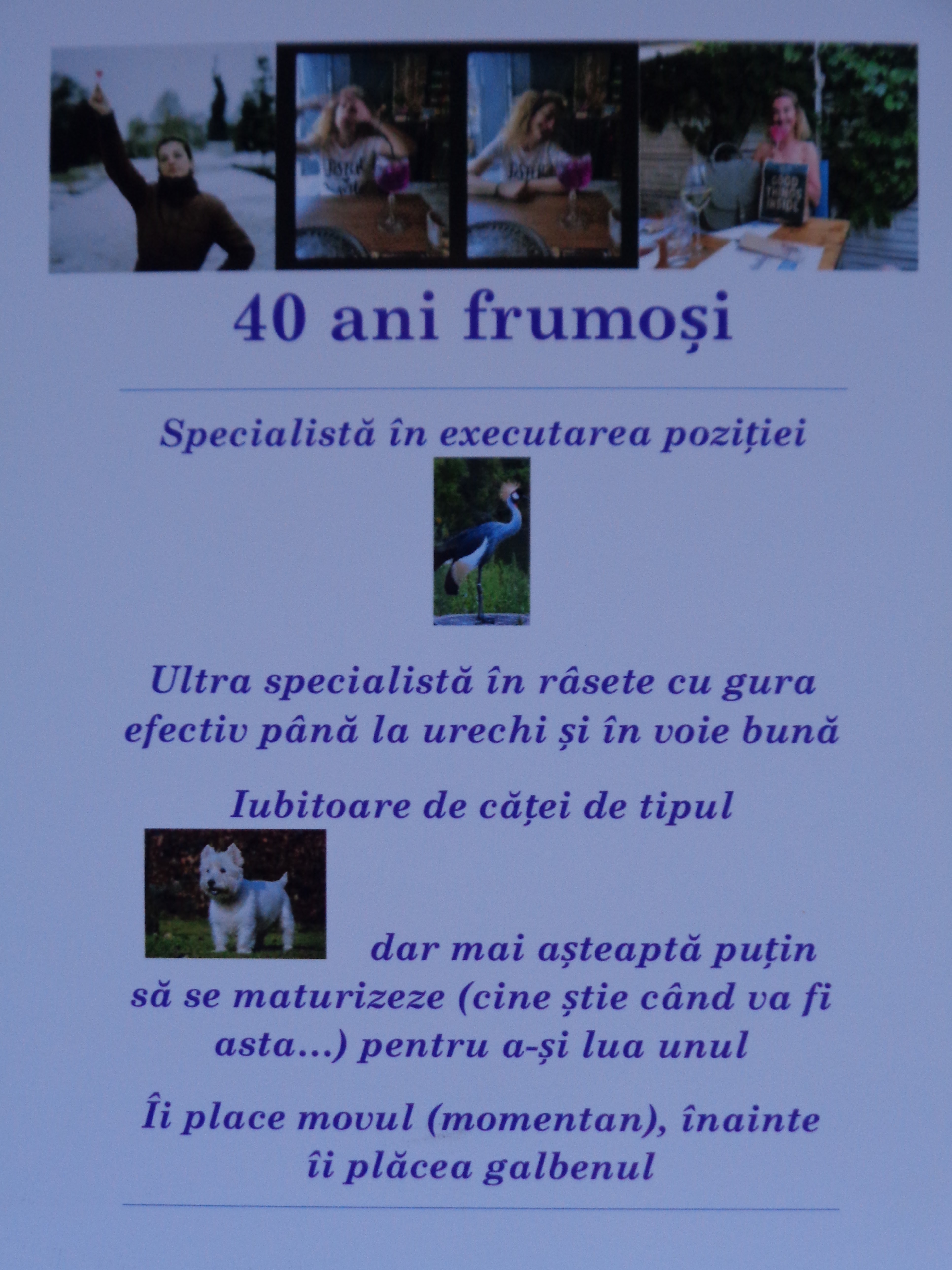
My nephew knows that I can be described as young and tall.

My friends and family know that I like the color purple and that I love dogs. But most of all, I love suprises. The funnier the better.

Recently, I have been told that I will turn 40. Anyway, so they say. Of course, those that do not usually ask me if I am legally allowed to drink alcohol. I’m fluffing up my feathers (since I’ve been compared to a crane) and keep on smiling.